Fractured Rocks
Natural fractures: from aperture to fluid flow¹
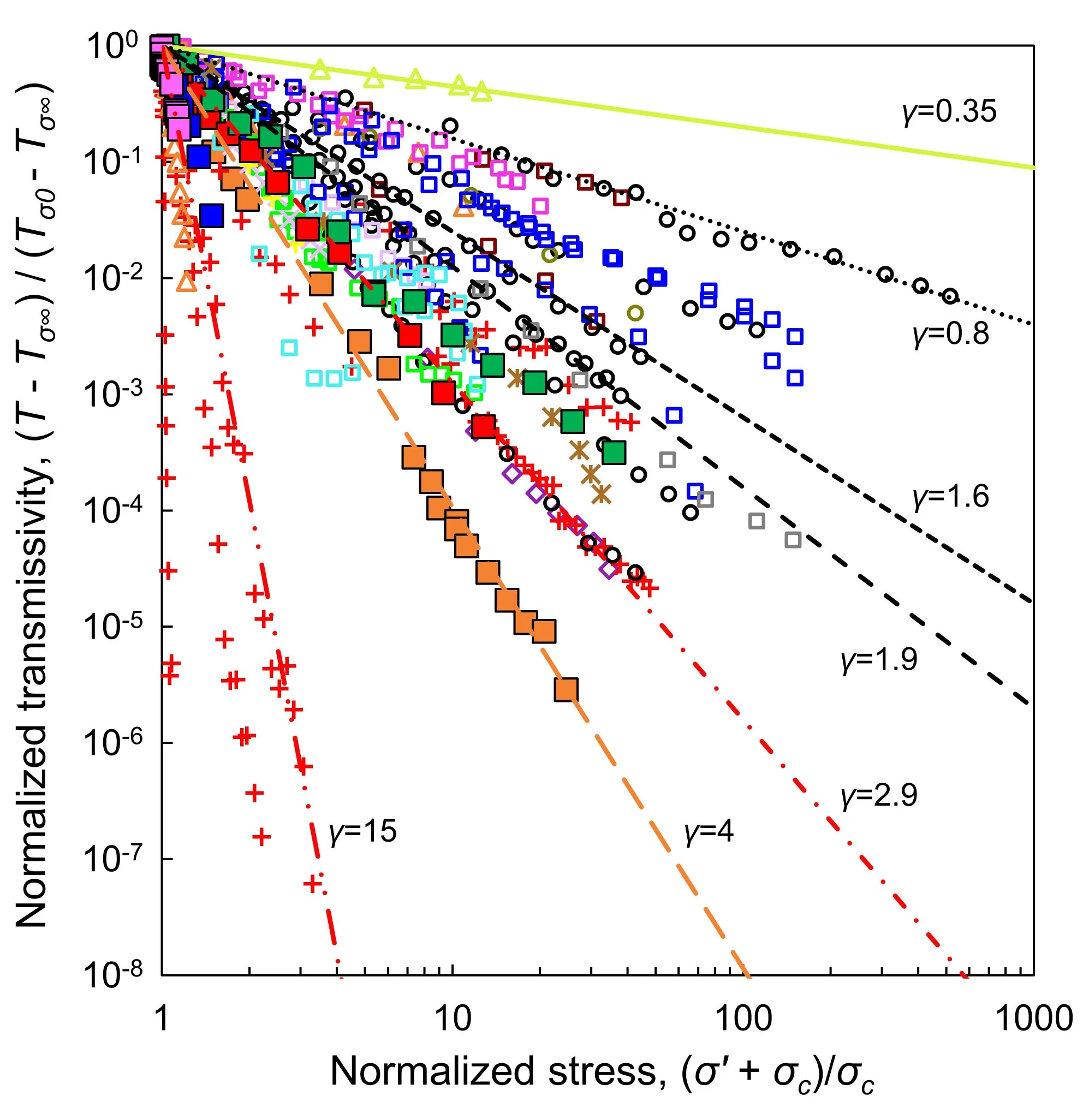
The void space between rough fracture surfaces governs fluid flow, controls fracture deformation during loading, and dilation during shear. We have explored both experimentally and numerically the combined effects of fracture roughness, matedness, and stresses to determine fluid flow behavior. We have shown that normal loading promotes flow channeling whereas shear induces anisotropy in the flow field¹. This insight is used to develop phenomenological models of fracture transmissivity with normal stress and shear displacement.
Fractures are mechanical discontinuities in rocks that occur at various scales, from microscopic to continental. They often serve as preferential flow pathways that define the rock mass internal “plumbing”. They are also planes of mechanical weakness, determining the stability of engineering and geological systems built on or within them. Therefore, understanding the hydraulic and mechanical behavior of fractures is critical for assessing their response to both natural and human-induced perturbations.
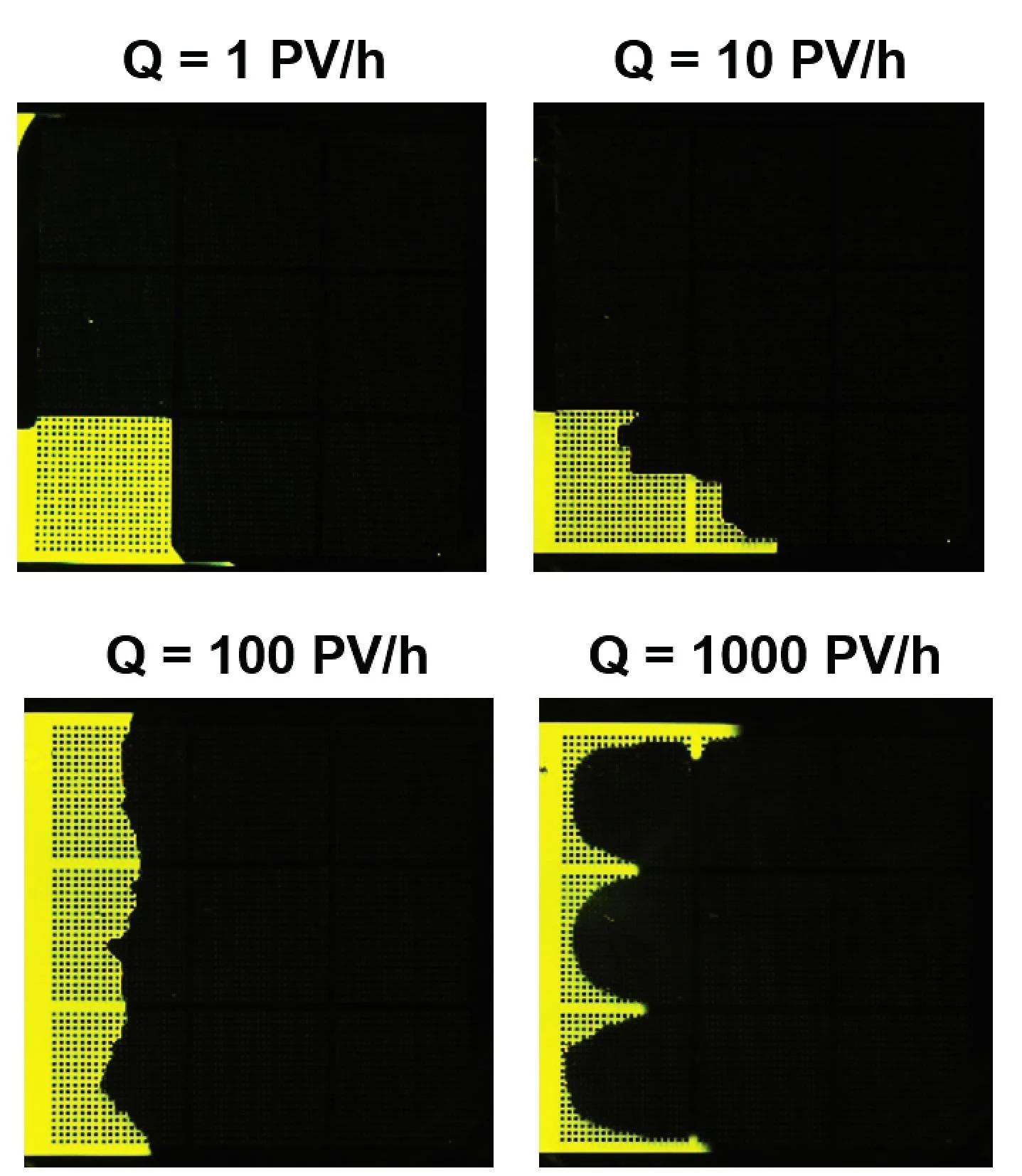
The balance between capillary, viscous, and gravity forces determine fluid invasion patterns in fractured porous media. To visualize these flow patterns, we use microfluidic experiments. We have demonstrated that the ratio between the advective flow in fractures and the capillary-driven imbibition in the matrix determines the invasion regime. At low injection rates, fractures may act as capillary barriers to imbibition. At high injection rates, the non-wetting trapped in the matrix is gradually displaced by imbibition along corner flow.
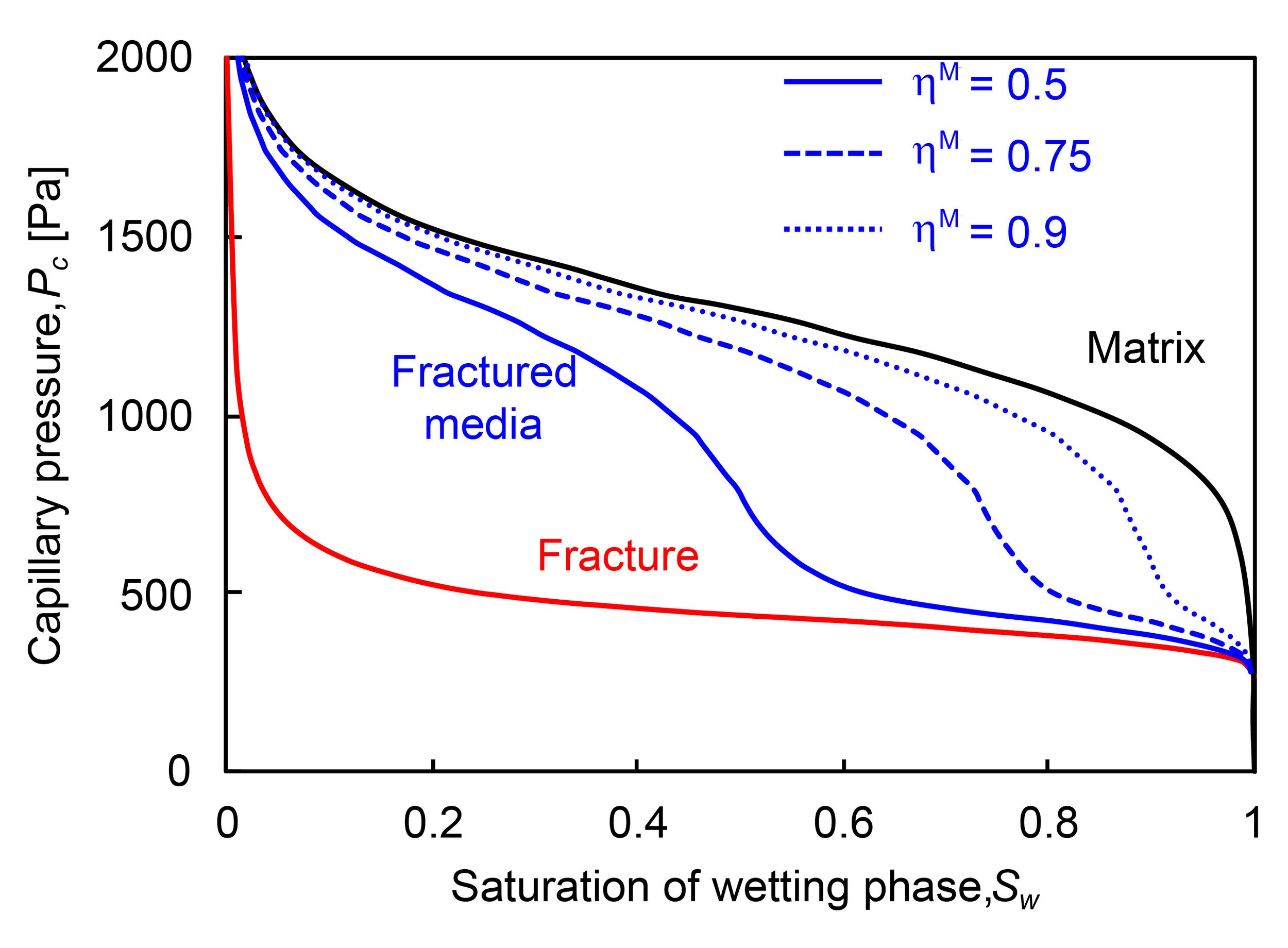
Capillary pressure vs. saturation for fractured rock masses³
The fractal topography of fracture surfaces challenges the upscaling of laboratory test results to the field scale. Therefore, we rely on “numerical experiments” to study capillary behavior in fractured rocks under long-term thermodynamic equilibrium. Our results show that the fracture capillary curve controls the entry pressure, whereas the matrix regulates the rock mass residual saturation at high capillary pressures.
Selected publications
¹Cardona A., Finkbeiner T., and Santamarina J.C. (2021). Natural Rock Fractures: From Aperture to Fluid Flow, Rock Mechanics and Rock Engineering, v. 54, p 5827-5844.doi:10.1007/s00603-021-02565-1
²Cardona A., and Santamarina J.C. (2023). Immiscible fluid displacement in fractured media: A dual porosity microfluidics study, International Journal of Rock Mechanics and Mining Sciences, v. 170, 105555. doi:10.1016/j.ijrmms.2023.105555
³Cardona A., Liu Q., and Santamarina J.C. (2023). The capillary pressure vs. saturation curve in a fractured rock mass: fracture and matrix contributions, Scientific Reports, v. 13, 12044. doi:10.1038/s41598-023-38737-y